

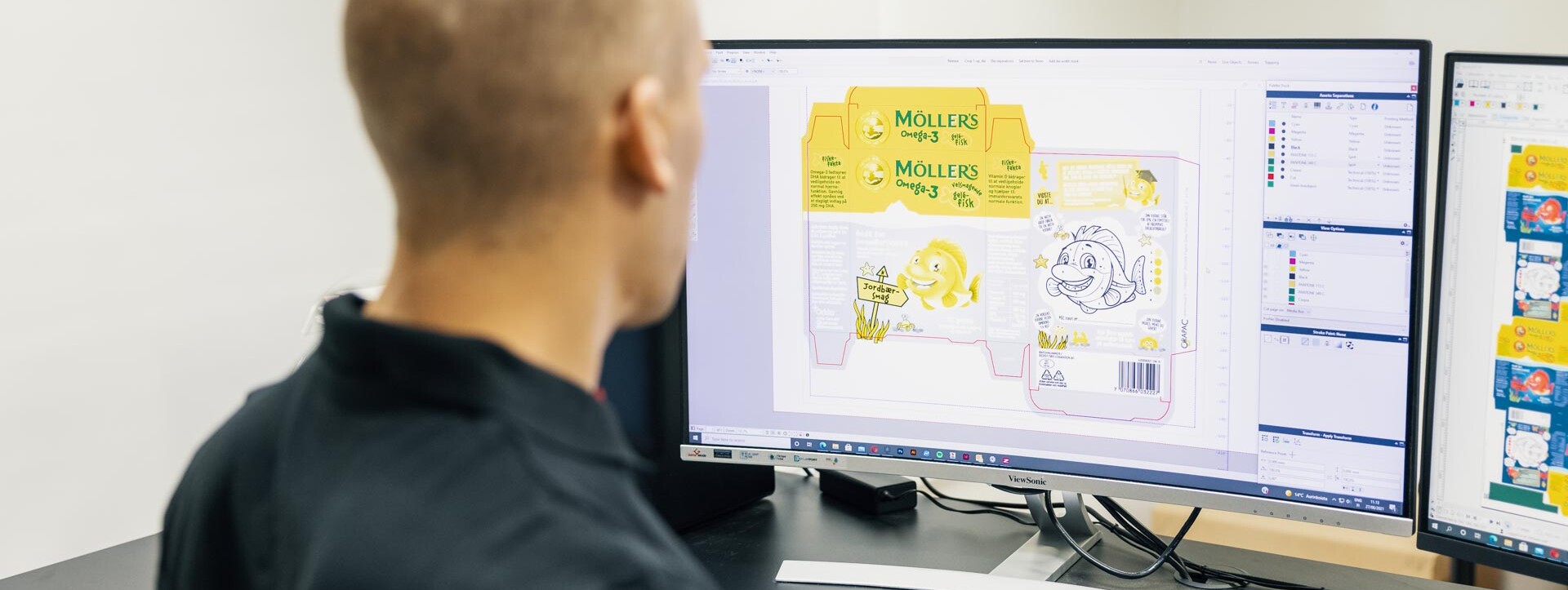

Correct artwork prevents errors and delays
Print material must meet the requirements of the selected printing method. Our prepress team checks file format, colours, images, fonts, bleed, the die line and special functions before the artwork proceeds to proofing and production.
Digital printing
Suitable for small and medium runs, multiple design versions and variable print information. Artwork is primarily prepared in CMYK and supplied as a print-ready PDF.
Offset printing
Provides high, consistent image quality with CMYK and/or Pantone colours. Images should normally be at least 300 ppi at final size, with at least 3 mm bleed.
Flexographic printing
Artwork is adapted to the material, press, screening and construction. Pantone and spot colours are common, and complex graphics should be reviewed by prepress at an early stage.
Technical artwork requirements
This table is a general starting point. The final specification is determined by the packaging material, construction, printing press and agreed quality level.
| Requirement | Digital printing | Offset printing | Flexographic printing |
|---|---|---|---|
| Recommended file format | Print-ready PDF, preferably PDF/X-4 | Print-ready PDF, preferably PDF/X-4 | Print-ready PDF, preferably PDF/X-4 |
| Source application | Adobe Illustrator or InDesign | Adobe Illustrator or InDesign | Adobe Illustrator or InDesign |
| Colour space | CMYK, spot colours when required | CMYK and/or Pantone | Primarily Pantone/spot colours; CMYK for process printing |
| Colour profile | According to the agreed print standard and material | According to the agreed print standard and material | Adapted to the substrate and printing process |
| Images | Recommended minimum 300 ppi at final size | Recommended minimum 300 ppi at final size | Assessed according to screening and print conditions |
| Bleed | At least 3 mm | At least 3 mm | According to the die line and construction |
| Fonts | Embedded or converted to outlines | Embedded or converted to outlines | Conversion to outlines recommended |
| Die line | Separate layer/spot colour; must not print | Separate layer/spot colour; must not print | Separate layer/spot colour; must not print |
| Special colours | Defined as separate spot colours | Defined as Pantone/spot colours | Defined as separate Pantone/spot colours |
| White ink | Separate spot colour/layer | Separate spot colour when required | Separate spot colour when required |
| Spot varnish | Separate spot colour/layer | Separate spot colour/layer | Separate spot colour/layer |
| Foil | Separate layer/spot colour | Separate layer/spot colour | Separate layer/spot colour |
| Embossing | Separate layer/spot colour | Separate layer/spot colour | Separate layer/spot colour |
Digital printing – colours and special functions
Colours should primarily be defined in CMYK. Corporate and product colours should also include a Pantone reference, although a Pantone colour cannot always be reproduced exactly as it is in offset or flexographic printing.
White ink, spot varnish and other special functions must be identified as separate spot colours, preferably on clearly named separate layers.
Offset printing – resolution, bleed and Pantone
Important text, logos and codes must be positioned at a sufficient safe distance from cutting, die-cutting and creasing lines. Pantone colours intended to print separately must not be converted to CMYK.
Images should normally have an effective resolution of at least 300 ppi at final size, and bleed graphics should extend at least 3 mm beyond the die line.
Flexographic printing – build artwork for the process
Screening, small text, thin lines, reversed elements, overprinting and registration must be assessed according to the material, press and construction. Complex artwork should be reviewed before it is finalised.
Die line and special functions
Always use the die line supplied for the packaging and do not alter it without approval. Cutting, creasing and construction lines must remain separate from print information and must not be rasterised or incorporated into the graphics.
White ink, varnish, foil and embossing should be specified as vector-based spot colours or layers, for example WHITE , VARNISH , FOIL and EMBOSS .
Proofing and customer approval
After the prepress check, we send a PDF proof. Check text, languages, spelling, product information, barcodes, graphic placement, colour specifications, Pantone numbers and that the correct artwork version is being used.
Production starts only after approval. A PDF proof primarily confirms content and placement; an ordinary monitor or office printer is not an exact reference for final print colours. Critical colour requirements need a separate colour proof or agreed colour reference.
Supply artwork in good time
Supply the artwork as soon as the construction and die line have been confirmed. It must be complete and approved before printing and production can be scheduled conclusively.
For new products, complex artwork, special colours, foil or embossing, contact Orapac during the design phase. Prepress can then verify technical feasibility before the artwork is finalised.
Find the prepress contact →